


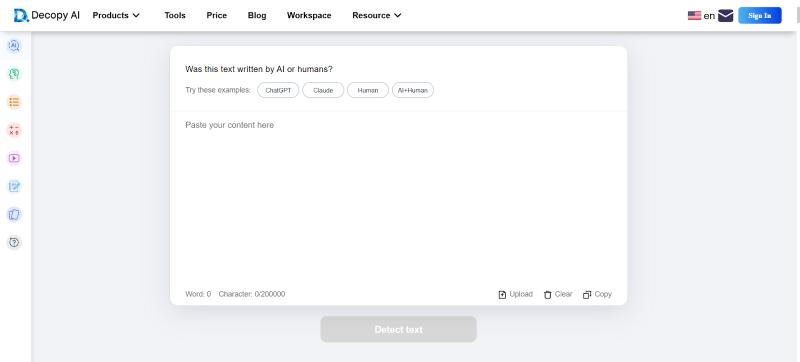
In the current digital ecosystem, we are witnessing a tectonic shift in how information is created, indexed, and consumed. The surge of Generative AI has democratized content production, allowing brands to churn out thousands of words in seconds. However, this convenience has birthed a new set of challenges: the erosion of trust and the increasing difficulty of maintaining search engine visibility. As Google’s algorithms become more sophisticated in identifying low-effort, automated fluff, the role of a high-performance ai detector has shifted from being a “police tool” to a vital strategic asset for every serious content marketer and SEO specialist.
The 2024 SEO Landscape: Why “Average” is the New “Invisible”
For years, SEO was a game of volume. If you published enough relevant keywords, you climbed the ranks. But those days are gone. With the rollout of the 2024 Helpful Content Updates and the refinement of the SpamBrain system, Google has sent a clear message: it doesn’t care who or what wrote the content, but it deeply cares about the value that content provides to the end-user.
The problem with most AI-generated drafts is that they are “statistically average.” Large Language Models (LLMs) work by predicting the most probable next word, which inherently leads to predictable, repetitive, and often bland prose. When search engine crawlers encounter thousands of pages that all sound identical-lacking unique data, fresh perspectives, or personal experience-they categorize them as “thin content.” This is where the risk lies. If your site is perceived as a farm for unedited AI output, your entire domain authority could suffer a catastrophic decline.
Decoding the Machine: Perplexity, Burstiness, and the “Human Touch”
To understand how to protect your rankings, you must understand how AI detection technology works. Most advanced systems analyze two primary linguistic markers: Perplexity and Burstiness.
1. Perplexity measures the randomness of the text. Humans are unpredictable; we use metaphors, slang, and non-linear logic. AI, conversely, aims for maximum clarity and probability, resulting in low perplexity.
2. Burstiness refers to sentence structure and length variation. A human writer might follow a long, complex philosophical sentence with a short, punchy one. AI tends to produce sentences of uniform length and rhythm.
By utilizing a professional-grade detection platform, you gain a “pre-flight check.” It allows you to see where your content feels too “flat” or predictable. The goal isn’t to delete the AI’s work but to identify which sections need “bursts” of human creativity. This proactive approach ensures that your content doesn’t just pass a technical test, but actually resonates with human readers who are increasingly weary of robotic-sounding brand communications.
The “Information Gain” Crisis in Content Marketing
One of the most overlooked factors in modern SEO is “Information Gain.” This refers to the new information a piece of content provides that hasn’t already been covered by other sites in the top 10 search results. AI models, by definition, are trained on existing data. They cannot perform original interviews, conduct new experiments, or offer a unique “take” on a breaking news story.
If your strategy relies solely on AI, your information gain score is effectively zero. To combat this, content creators must use AI as a foundational layer-a sophisticated drafting tool-and then layer on top the “E-E-A-T” elements (Experience, Expertise, Authoritativeness, Trust).
A standard workflow for a high-performing content team should look like this:
● Ideation and Outlining: Use AI to brainstorm structures and ensure all basic subtopics are covered.
● Initial Drafting: Generate the bulk of the text to save time on research and basic phrasing.
● Detection Audit: Run the draft through a tool to pinpoint the most “machine-like” paragraphs.
● Human Optimization: This is the most crucial step. A human editor must inject personal anecdotes, link to original case studies, and refine the tone to match the brand’s specific voice.
Beyond Rankings: Building Consumer Trust in an AI-Saturated World
Content marketing is not just about pleasing an algorithm; it’s about building a relationship with an audience. As the internet becomes flooded with synthetic media, “Authenticity” is becoming a premium commodity. Users are developing an “AI-radar”-a subconscious ability to detect when they are being marketed to by a script rather than a person.
When a customer reads a blog post that feels genuinely helpful and human, their trust in the brand increases. Conversely, if they feel they are reading a generic GPT-generated response, that trust evaporates. For businesses, this is a high-stakes game. Using a detection tool is a way of ensuring your brand’s “soul” remains intact across all digital touchpoints. It’s about quality control in an age of infinite quantity.
The Hidden Costs of Content Automation
While the cost of generating a 2000-word article with AI is pennies, the hidden costs of unrefined AI content can be massive. These include:
● Higher Bounce Rates: Users leave faster when they don’t find a unique voice.
● Loss of Backlink Potential: No one wants to link to a generic article that says nothing new.
● Legal and Ethical Risks: AI can occasionally hallucinate facts or inadvertently plagiarize structures, leading to potential copyright issues.
By integrating a verification layer, you mitigate these risks. You ensure that every piece of content that leaves your CMS is a polished, verified, and high-value asset that contributes to your long-term SEO strategy rather than detracting from it.
Integrating Technology for Long-Term Success
The future belongs to the “Cyborg Content Creator”-the professional who knows how to leverage the speed of machines while maintaining the nuance of humanity. We are entering an era where transparency will likely become a ranking factor. Soon, we may see “Human-Verified” badges becoming as common as SSL certificates.
In this competitive landscape, having a reliable ai content detector is like having a compass in a storm. It gives you the data you need to make informed decisions about your content’s quality. It helps you decide when a draft is “good enough” and when it needs that extra 20% of human effort that results in 80% of the SEO gains. Don’t let your content strategy become a victim of its own efficiency. Use the right tools to ensure that your voice remains distinct, your information remains valuable, and your rankings remain secure in an increasingly automated world.
Company Details
Ranksitetool is a SEO Marketing agency based in the UK, helping clients across the globe. In just a few years, we’ve rapidly grown into a leading agency specializing in Marketing, SEO, and Content solutions.
Contact:
Mail: kevinbrian.seo123@gmail.com
Phone: +44 7521 013847
https://ranksitetool.com/
This release was published on openPR.
link