Digital Marketing Market Size to Hit USD 1,189.5 Billion by 2033 |
Digital Marketing Market
Market Overview:
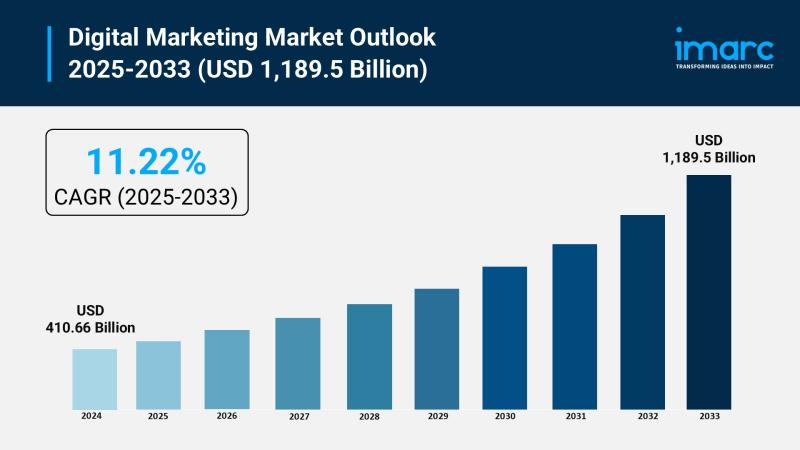
The digital marketing market is experiencing rapid growth, driven by integration of generative ai and agentic workflows, expansion of social commerce and mobile ecosystems, and government digitalization and data sovereignty initiatives. According to IMARC Group’s latest research publication, “Digital Marketing Market Size, Share, Trends and Forecast by Digital Channel, End Use Industry, and Region, 2025-2033”, the global digital marketing market size was valued at USD 410.66 Billion in 2024. Looking forward, IMARC Group estimates the market to reach USD 1,189.5 Billion by 2033, exhibiting a CAGR of 11.22% from 2025-2033.
This detailed analysis primarily encompasses industry size, business trends, market share, key growth factors, and regional forecasts. The report offers a comprehensive overview and integrates research findings, market assessments, and data from different sources. It also includes pivotal market dynamics like drivers and challenges, while also highlighting growth opportunities, financial insights, technological improvements, emerging trends, and innovations. Besides this, the report provides regional market evaluation, along with a competitive landscape analysis.
Download a sample PDF of this report: https://www.imarcgroup.com/digital-marketing-market/requestsample
Our report includes:
● Market Dynamics
● Market Trends and Market Outlook
● Competitive Analysis
● Industry Segmentation
● Strategic Recommendations
Growth Factors in the Digital Marketing Market
Integration of Generative AI and Agentic Workflows
The adoption of generative artificial intelligence has become the primary engine for efficiency and scale within the global digital marketing sector. Currently, approximately 92% of businesses are actively investing in generative AI tools to streamline their operations. This shift is moving beyond simple content generation toward “agentic AI,” where autonomous agents handle complex workflows such as demand forecasting and hyper-personalization. Research indicates that 79% of companies have already begun adopting AI agents, with two-thirds of these organizations reporting significant value delivery. Furthermore, around 51% of marketing teams now utilize these advanced tools specifically to optimize content for email campaigns and search engine visibility. Industry leaders like Adobe and Salesforce have highlighted that 64% of organizations using these technologies report a much higher volume of content production, allowing brands to maintain a constant digital presence without a proportional increase in human resource costs.
● Expansion of Social Commerce and Mobile Ecosystems
Social media platforms have successfully transitioned from mere engagement hubs into full-funnel retail environments, fundamentally altering the path to purchase. The global social commerce market is currently seeing massive activity, with platforms like Instagram and TikTok integrating shoppable feeds and “live commerce” features that reduce the friction between discovery and conversion. For instance, Instagram currently supports an estimated 46.8 million active buyers, while TikTok’s commerce features have attracted over 35.3 million shoppers. This growth is heavily supported by the widespread adoption of 4G and 5G enabled smartphones, with 96% of global users now accessing the internet via mobile devices. Company activities, such as Coca-Cola’s hashtag-driven campaigns and the rise of social reselling platforms like Meesho, demonstrate how brands are leveraging peer-validated content to drive revenue. Global in-app spending has crossed the $390 billion mark, solidifying mobile-centric social commerce as a critical growth driver.
● Government Digitalization and Data Sovereignty Initiatives
Strategic government programs and evolving regulatory frameworks are providing a structured environment that encourages digital marketing investment while ensuring consumer safety. Initiatives like India’s “Digital India” and the “National Program on Artificial Intelligence” have created a robust infrastructure for digital trade, leading to a surge in internet penetration and electronic governance. The 2026 National Awards for e-Governance received over 800 nominations for technological transformation, highlighting the massive scale of public-sector digital adoption. Simultaneously, the implementation of strict data privacy laws, such as the Digital Personal Data Protection Act, is forcing a shift toward high-quality, consent-based marketing. These initiatives provide the legal and technical scaffolding necessary for a trusted digital economy. By standardizing digital identities and promoting secure data exchange through “API Setu” and other gateways, governments are enabling marketers to reach previously untapped rural and semi-urban populations with greater precision and security.
Key Trends in the Digital Marketing Market
● The Rise of Generative Engine Optimization (GEO)
Traditional search engine optimization is rapidly evolving into Generative Engine Optimization as AI-powered summaries become the primary way users consume information. In 2026, the focus has shifted from ranking for specific keywords to becoming a cited authority within AI-generated overviews provided by tools like Google’s Search Generative Experience. Marketers are now prioritizing “structured data” and “schema markup” to ensure their brand information is easily interpretable by large language models. Statistics show that 83.7% of businesses are currently investing in AI visibility, recognizing that appearing as a cited source in an AI summary is more valuable than a traditional blue-link ranking. This trend emphasizes “topical depth” over keyword density, as AI systems prioritize content that demonstrates verifiable expertise and first-hand experience. Consequently, brands are rebuilding their content ecosystems to serve as data libraries for these intelligent discovery engines.
● Authenticity Through User-Generated Content Flywheels
In an era dominated by AI-generated assets, authentic User-Generated Content (UGC) has emerged as a high-conversion machine. Brands are moving away from polished, one-off influencer posts toward “UGC flywheels” where real customer videos and reviews are systematically integrated into the marketing stack. Current data reveals that over 80% of consumers believe UGC significantly improves brand trust and product discovery. To capitalize on this, companies are using AI tools to identify, curate, and request permissions for high-performing organic content at scale. For example, fashion and beauty brands frequently recycle unboxed videos and “honest reviews” directly into their paid social advertisements. This trend represents a move toward “human-first media,” where the relatability of a micro-influencer or a regular customer carries more weight than high-production celebrity endorsements. This shift ensures that marketing remains grounded in peer validation and genuine community engagement.
● Privacy-Centric Personalization and First-Party Data
The phase-out of third-party cookies has led to the emergence of privacy-centric marketing, where brands rely exclusively on first-party data collected through direct interactions. In 2026, trust has become a competitive advantage; 73% of customers expect personalized experiences but only if their data is handled ethically. Marketers are responding by implementing “Consent Management Platforms” and “zero-party data” strategies, where users voluntarily share preferences in exchange for tangible benefits, such as customized loyalty rewards or interactive quizzes. For instance, brands like Patagonia and IKEA use interactive AR tools and preference centers to gather data while providing immediate value to the user. This trend is characterized by “predictive targeting” based on owned CRM data rather than intrusive cross-site tracking. By prioritizing transparency and secure data practices, businesses are building long-term digital trust while still delivering the hyper-personalized experiences that modern consumers demand.
Access the Latest 2026 Data & Forecasts: https://www.imarcgroup.com/checkout?id=7572&method=3451
Leading Companies Operating in the Global Digital Marketing Industry:
● 97th Floor
● Cuker
● Disruptive Advertising
● Ignite Visibility
● Location3 Media
● PB&J Promotions LLC
● Rise Interactive (Quad)
● Split Reef LLC
● Thrive Internet Marketing Agency
● TopSpot Internet Marketing
● WebFX
● Webimax
Digital Marketing Market Report Segmentation:
By Digital Channel:
● Email Marketing
● Search Engine Optimization (SEO)
● Interactive Consumer Website
● Online/Display Advertising
● Blogging and Podcasting (Including Microblogging)
● Social Network Marketing
● Mobile Marketing
● Viral Marketing
● Digital OOH Media
● Online Video Marketing
● Others
Social network marketing represents the largest segment owing to the increasing number of individuals using social media platforms to connect with others.
By End Use Industry:
● Automotive
● BFSI
● Education
● Government
● Healthcare
● Media and Entertainment
● Others
On the basis of the end use industry, the market has been divided into automotive, BFSI, education, government, healthcare, media and entertainment, and others.
Regional Insights:
● North America (United States, Canada)
● Asia Pacific (China, Japan, India, South Korea, Australia, Indonesia, Others)
● Europe (Germany, France, United Kingdom, Italy, Spain, Russia, Others)
● Latin America (Brazil, Mexico, Others)
● Middle East and Africa
North America’s dominance in the market is attributed to the increasing adoption of digital marketing among businesses to connect with their target audience.
Note: If you require specific details, data, or insights that are not currently included in the scope of this report, we are happy to accommodate your request. As part of our customization service, we will gather and provide the additional information you need, tailored to your specific requirements. Please let us know your exact needs, and we will ensure the report is updated accordingly to meet your expectations.
About Us:
IMARC Group is a global management consulting firm that helps the world’s most ambitious changemakers to create a lasting impact. The company provide a comprehensive suite of market entry and expansion services. IMARC offerings include thorough market assessment, feasibility studies, company incorporation assistance, factory setup support, regulatory approvals and licensing navigation, branding, marketing and sales strategies, competitive landscape and benchmarking analyses, pricing and cost research, and procurement research.
Contact Us:
IMARC Group
134 N 4th St. Brooklyn, NY 11249, USA
Email: [email protected]
Tel No:(D) +91 120 433 0800
United States: +1-201971-6302
This release was published on openPR.
link