Inside the shift from manual to smart content supply chains: How you can transform your content creation strategy
The playbook for content creation is being rewritten. As digital channels multiply and audiences demand relevance at every touchpoint, brands can no longer rely on slow, manual production models to keep pace. What once worked for campaign-based marketing is now being stretched by always-on engagement, real-time platforms, and the growing expectation for personalised experiences.
In response, forward-looking brands are rethinking how content is planned, created, and delivered—shifting from fragmented workflows to more connected, intelligent content supply chains. By embracing automation, data-driven insights, and modular content systems, they are unlocking the ability to scale production while tailoring messages to individuals, not segments.
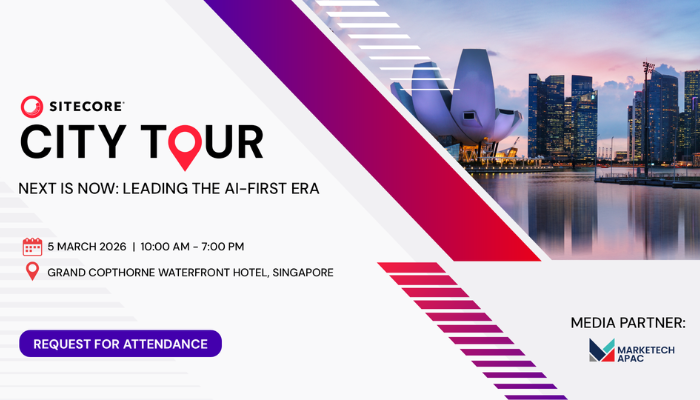
In order to equip brands with the much-needed skillsets and tools for this transformation, Sitecore is launching its Sitecore City Tour Asia 2026 – Singapore event, which will be held on 5 March 2026 at Grand Copthorne Waterfront Hotel, Singapore.
What to expect
The event, with MARKETECH APAC serving as media partner, will focus on deep-dive sessions, hands-on demonstrations, and networking with industry pioneers, centred around the theme on revolutionising content supply chains— from manual production to automated, hyper-personalised experiences.
These include:
- AI in action: Live demos, real-world case studies from leading brands, and an exciting hackathon showcasing innovation in action
- Personalisation at scale: See how SitecoreAI is driving tailored experiences across channels
- Demo stations and executive meetings: Hands-on exploration of Sitecore’s unified platform
- Future forward insights: Perspectives from industry experts, Microsoft and leading analysts
- Peer-to-peer networking: Connect with industry leaders, Sitecore experts, and innovators
As customer expectations evolve at speed, brands need agile, intelligent frameworks to deliver personalised, connected experiences at scale. This event will equip attendees with practical insights and tools to harness generative AI for next-level personalisation, accelerate business outcomes by scaling AI-driven marketing for measurable ROI, and transform customer interactions—future-proofing engagement strategies and leading organisations confidently into the AI-first era.
Speakers at the event include:
- Simon Kemp – Founder, Kepios & Chief Analyst, DataReportal
- Avi Liran (CSP) – Global Chief Delighting Officer, Delivering Delight
- Ben Israel – Partner, Deloitte Digital
- Nicholas Smith – Principal, Digital Strategy, Fortescue
- Ashley Kalb – Digital Product Manager, Melbourne Racing Club
- Joey Lim – President, APJ, Sitecore
- Mick Wingert – Director, Solution Engineering, APJ, Sitecore
- Roger Connolly – Chief Product Officer, Sitecore
- Zac Lin – Area Vice President, Asia, Sitecore
Addressing new market shifts
For Joey Lim, president, APJ, Sitecore, the way customers make decisions has changed, and that today, that path is far less controlled.
“In the past, brands could assume a more linear journey. A customer might see an ad, visit a website, download a guide, and then speak to sales. Brands could design for that path and measure progress step by step,” she said.
She added, “Customers ask questions in AI tools. They compare options in search. They read reviews. They encounter recommendations in social feeds. They form opinions from summaries and rankings that pull information from many sources. Often, a decision is shaped before someone ever lands on a brand’s website.”
For her, these changes create three clear priorities for marketers: visibility, personalisation, and orchestration.
- Visibility – If you are not showing up in the right language and context, you do not show up at all. AI systems summarise. Search engines rank. Feeds filter. If your content is inconsistent or unclear, it will not surface when customers are forming opinions.
- Personalisation – Customers expect brands to speak to them in ways that feel natural and relevant. They expect consistency across markets and channels. If a brand answers the same question differently depending on where it appears, trust declines.
- Orchestration – Global teams need to move quickly without creating bottlenecks, duplicating work, or losing governance. Content should be created once, adapted intelligently, and activated across regions and channels from a shared foundation. Without coordination, scale creates confusion.
“At the same time, many organisations are struggling with internal complexity. Content lives in multiple systems. Data is disconnected. Teams operate in silos. AI is often layered on top rather than embedded into how marketing works. Boards are no longer asking whether to use AI. They are asking how it improves measurable outcomes. Can it reduce costs? Increase conversion? Accelerate execution? The focus is on performance,” Joey explained.
In light of these industry challenges, Joey stresses how this event is timely, as it brings leaders together to discuss how to structure content so it can be found and trusted by both people and machines, how to connect systems so personalisation is consistent, and how to orchestrate global marketing without losing control.
“This conversation is timely because the brands that show up clearly and consistently in this new environment will influence decisions. The brands that do not will struggle to be seen,” she said.
The future of customer engagement in the age of AI
When asked what lies ahead for customer engagement, Joey noted that as customer engagement is becoming faster and more distributed–and that visibility, personalisation, and orchestration define competitiveness.
“Those answers influence trust and choice before a customer visits a site. Brands are no longer experienced as a single narrative. They are experienced as fragments across many surfaces,” she said.
In terms of what defines said competitiveness, Joey highlighted the following:
- Visibility means your brand appears clearly when customers ask questions.
- Personalisation means every interaction feels relevant without contradicting the brand’s core message.
- Orchestration means teams operate from a shared system so speed does not undermine consistency or governance.
“AI will accelerate this shift. It can help teams move faster, adjust content based on intent, and measure performance more precisely. But AI alone is not the advantage. Clarity and coordination are,” she said.
Moreover, she also shared that for brands to stay competitive, they need these three mindset shifts:
- From producing more content to structuring it for visibility – Content must be designed to surface in the moments that influence decisions.
- From isolated campaigns to consistent personalisation – Relevance must reinforce the same core answer across markets and channels.
- From AI pilots to operational discipline – AI should improve measurable outcomes such as speed, conversion, cost efficiency, and retention. It should be embedded into daily workflows.
“AI does not replace marketers. It reduces manual effort so teams can focus on strategy, creativity, and building trust. The brands that lead in an AI-first era will be those that show up clearly, speak consistently, and operate as one coordinated system,” she concluded.
Join Sitecore City Tour Asia 2026 – Singapore by clicking the link HERE and explore the future of customer engagement.
link